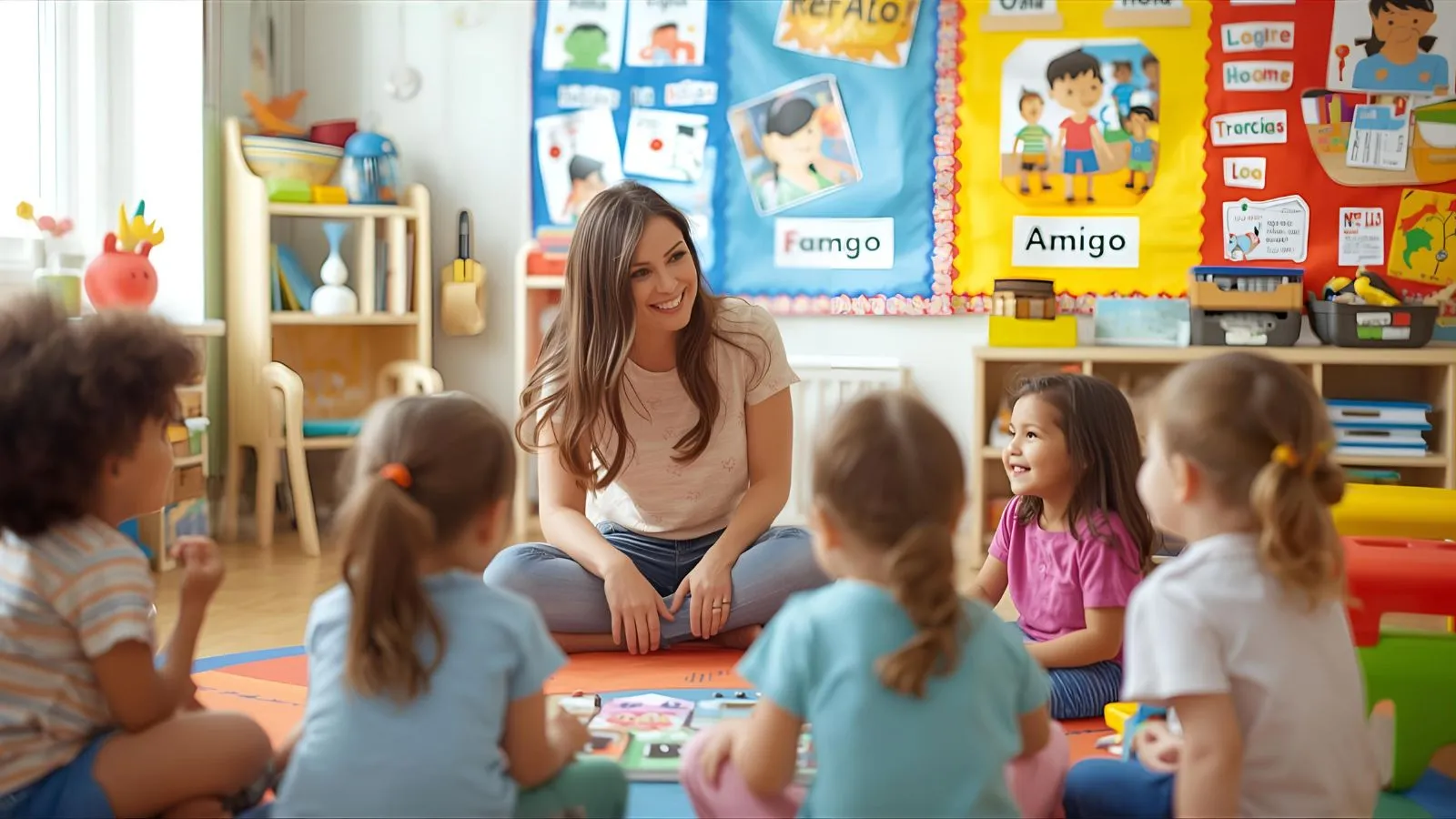
Teaching kindergarten is magical but it can be challenging when language becomes a barrier.
That’s where Spanish phrases for kindergarten teachers come in handy.
These phrases help teachers communicate better with Spanish-speaking students, creating an environment where every child feels seen, heard, and loved.
If it’s greeting a child warmly, giving simple instructions, or offering comfort when they feel shy, the right words make a big difference.
For teachers in bilingual classrooms or those with diverse learners, these Spanish phrases are a bridge to trust and understanding.
Why It Matters: The Power of Language in Early Learning 💬
Using Spanish phrases for kindergarten teachers goes beyond communication—it builds relationships. Imagine a child walking into class, nervous because they don’t understand English. Then they hear you say, “¡Buenos días! ¿Cómo estás?” (Good morning! How are you?)—suddenly, their eyes light up.
That moment of connection encourages trust and learning.
Language is one of the strongest tools teachers have. When educators use a few Spanish phrases:
- Students feel respected and valued.
- Parents appreciate the effort to communicate.
- The classroom becomes more inclusive and harmonious.
Even a handful of phrases can transform a teacher’s interaction with students. It’s not about being fluent—it’s about showing care, effort, and empathy.
Now, let’s explore categories of useful Spanish phrases that every kindergarten teacher can use.
Everyday Greetings and Warm Welcomes 🌞
Warm greetings help start the day with positivity and connection. Simple words can make children feel safe and ready to learn.
¡Buenos días! (Good morning!)
Use When: Welcoming students at the start of the day.
Example: “¡Buenos días, clase!” (Good morning, class!)
¿Cómo estás? (How are you?)
Use When: Checking in with students emotionally.
Example: “¿Cómo estás hoy, Ana?” (How are you today, Ana?)
¡Bienvenidos! (Welcome!)
Use When: Welcoming new students or parents.
Example: “¡Bienvenidos a nuestra clase de kínder!” (Welcome to our kindergarten class!)
Adiós / Hasta luego (Goodbye / See you later)
Use When: Saying goodbye after class.
Example: “¡Adiós, niños! ¡Hasta mañana!” (Goodbye, kids! See you tomorrow!)
Classroom Instructions and Routines 🖍️
Consistency helps children feel secure. These Spanish classroom phrases make routines easier to follow.
Siéntate, por favor. (Sit down, please.)
Use When: Starting circle time or lessons.
Example: “Siéntate, por favor, en tu silla.” (Sit down, please, in your chair.)
Levántate. (Stand up.)
Use When: Transitioning to another activity.
Example: “Levántate para cantar la canción.” (Stand up to sing the song.)
Haz una fila. (Make a line.)
Use When: Lining up for recess or activities.
Example: “Haz una fila para ir afuera.” (Make a line to go outside.)
Escucha, por favor. (Listen, please.)
Use When: Getting attention during story time.
Example: “Escucha, por favor, la historia.” (Listen to the story, please.)
Guarda tus cosas. (Put away your things.)
Use When: Cleaning up after activities.
Example: “Guarda tus cosas antes de ir a casa.” (Put away your things before going home.)
Encouragement and Praise 🌟
Positive reinforcement helps build confidence and motivation. These cheerful phrases are perfect for young learners.
¡Muy bien! (Very good!)
Use When: Praising effort or achievement.
Example: “¡Muy bien, Mateo! Dibujaste un sol hermoso.” (Very good, Mateo! You drew a beautiful sun.)
¡Excelente trabajo! (Excellent job!)
Use When: Celebrating success.
Example: “¡Excelente trabajo, clase!” (Excellent job, class!)
¡Buen intento! (Good try!)
Use When: Encouraging persistence.
Example: “¡Buen intento! Sigue practicando.” (Good try! Keep practicing.)
¡Eres muy inteligente! (You’re very smart!)
Use When: Boosting self-esteem.
Example: “¡Eres muy inteligente, Sofía!” (You’re very smart, Sofía!)
Managing Behavior and Emotions 💖

Kindergarten teachers deal with big feelings daily. These Spanish emotional phrases help guide behavior with empathy.
Tranquilo/a. (Calm down.)
Use When: A child feels upset or overwhelmed.
Example: “Tranquilo, todo está bien.” (Calm down, everything’s okay.)
No pasa nada. (It’s okay / Don’t worry.)
Use When: Comforting after small mistakes.
Example: “No pasa nada, podemos intentarlo otra vez.” (It’s okay, we can try again.)
Escúchame, por favor. (Listen to me, please.)
Use When: Redirecting attention gently.
Example: “Escúchame, por favor, y luego jugamos.” (Listen to me, please, and then we’ll play.)
Respira profundo. (Take a deep breath.)
Use When: Helping with self-regulation.
Example: “Respira profundo conmigo.” (Take a deep breath with me.)
Learning and Academic Phrases 📚
Support bilingual learning with Spanish phrases for classroom learning.
Repite después de mí. (Repeat after me.)
Use When: Teaching pronunciation or vocabulary.
Example: “Repite después de mí: casa.” (Repeat after me: house.)
Colorea dentro de las líneas. (Color inside the lines.)
Use When: Giving art directions.
Example: “Colorea dentro de las líneas, por favor.” (Color inside the lines, please.)
Cuenta los números. (Count the numbers.)
Use When: Teaching math or counting.
Example: “Cuenta los números conmigo.” (Count the numbers with me.)
Escoge la respuesta correcta. (Choose the correct answer.)
Use When: During simple assessments.
Example: “Escoge la respuesta correcta del dibujo.” (Choose the correct answer from the picture.)
Comfort and Care Phrases 💕
Small words of comfort create big emotional safety.
¿Te duele algo? (Does something hurt?)
Use When: Checking on a child who seems hurt.
Example: “¿Te duele algo? Vamos a la enfermería.” (Does something hurt? Let’s go to the nurse.)
Todo está bien. (Everything’s okay.)
Use When: Soothing fears or worries.
Example: “Todo está bien, no tengas miedo.” (Everything’s okay, don’t be afraid.)
Necesitas ayuda. (You need help.)
Use When: Offering assistance.
Example: “Parece que necesitas ayuda con tus zapatos.” (It looks like you need help with your shoes.)
Ven aquí. (Come here.)
Use When: Inviting a child closer gently.
Example: “Ven aquí, vamos a hablar.” (Come here, let’s talk.)
Parent Communication Phrases 🏫
Building trust with parents is essential. These Spanish phrases for teachers help in simple conversations with families.
Su hijo lo hizo muy bien hoy. (Your child did very well today.)
Use When: Sharing positive feedback.
Example: “Su hijo lo hizo muy bien en la actividad de lectura.” (Your child did very well in the reading activity.)
Necesitamos hablar sobre su progreso. (We need to talk about their progress.)
Use When: Setting up a meeting.
Example: “Necesitamos hablar sobre su progreso en matemáticas.” (We need to talk about their progress in math.)
Gracias por venir. (Thank you for coming.)
Use When: Closing a parent meeting.
Example: “Gracias por venir hoy.” (Thank you for coming today.)
Nos vemos mañana. (See you tomorrow.)
Use When: Ending the day or conversation warmly.
Example: “Nos vemos mañana, señora García.” (See you tomorrow, Mrs. García.)
Songs and Fun Phrases for Playtime 🎵
Kids love learning through music and play!
¡Vamos a cantar! (Let’s sing!)
Use When: Starting a song.
Example: “¡Vamos a cantar nuestra canción de los números!” (Let’s sing our number song!)
¡A jugar! (Let’s play!)
Use When: Beginning playtime.
Example: “¡A jugar en el patio!” (Let’s play on the playground!)
¡Baila conmigo! (Dance with me!)
Use When: During dance activities.
Example: “¡Baila conmigo y diviértete!” (Dance with me and have fun!)
¡Muy divertido! (So much fun!)
Use When: Celebrating playtime.
Example: “¡Fue muy divertido, niños!”
Bonus Recap Table 🧩
| Category | Example Phrase | Meaning | Use When |
|---|---|---|---|
| Greetings | ¡Buenos días! | Good morning | Starting the day |
| Classroom Routine | Siéntate, por favor. | Sit down, please | Beginning lessons |
| Praise | ¡Muy bien! | Very good | Praising effort |
| Emotions | Tranquilo/a. | Calm down | Comforting a student |
| Learning | Repite después de mí. | Repeat after me | Teaching vocabulary |
| Care | Todo está bien. | Everything’s okay | Reassuring a child |
| Parents | Gracias por venir. | Thank you for coming | Ending meetings |
| Fun | ¡Vamos a cantar! | Let’s sing | Starting song time |
Final Thoughts
Using Spanish phrases for kindergarten teachers isn’t just about translation it’s about connection. When teachers use even a few Spanish words, they show love and understanding that goes far beyond the classroom walls.
Learn a few phrases this week, use them daily, and watch how your students’ smiles grow brighter. You don’t need perfect grammar just genuine effort and kindness.

Leave a Reply