
Traveling to the Netherlands is exciting, colorful, and full of warm-hearted people.
From the peaceful canals of Amsterdam to the cozy cafés in Utrecht, every moment feels magical.
But there’s one thing that can make your trip even better knowing a few Dutch phrases for tourists.
Learning simple words and expressions helps you connect with locals, ask for help, order food, shop with confidence, and explore with ease.
This guide breaks down the most useful Dutch travel phrases into clear, friendly categories.
Each phrase includes an explanation, a quick “use when” tip, and an example. By the end, you’ll feel ready to say “Hallo!” with confidence and enjoy every moment like a local.
Why Dutch Phrases for Tourists Matter 🇳🇱💬
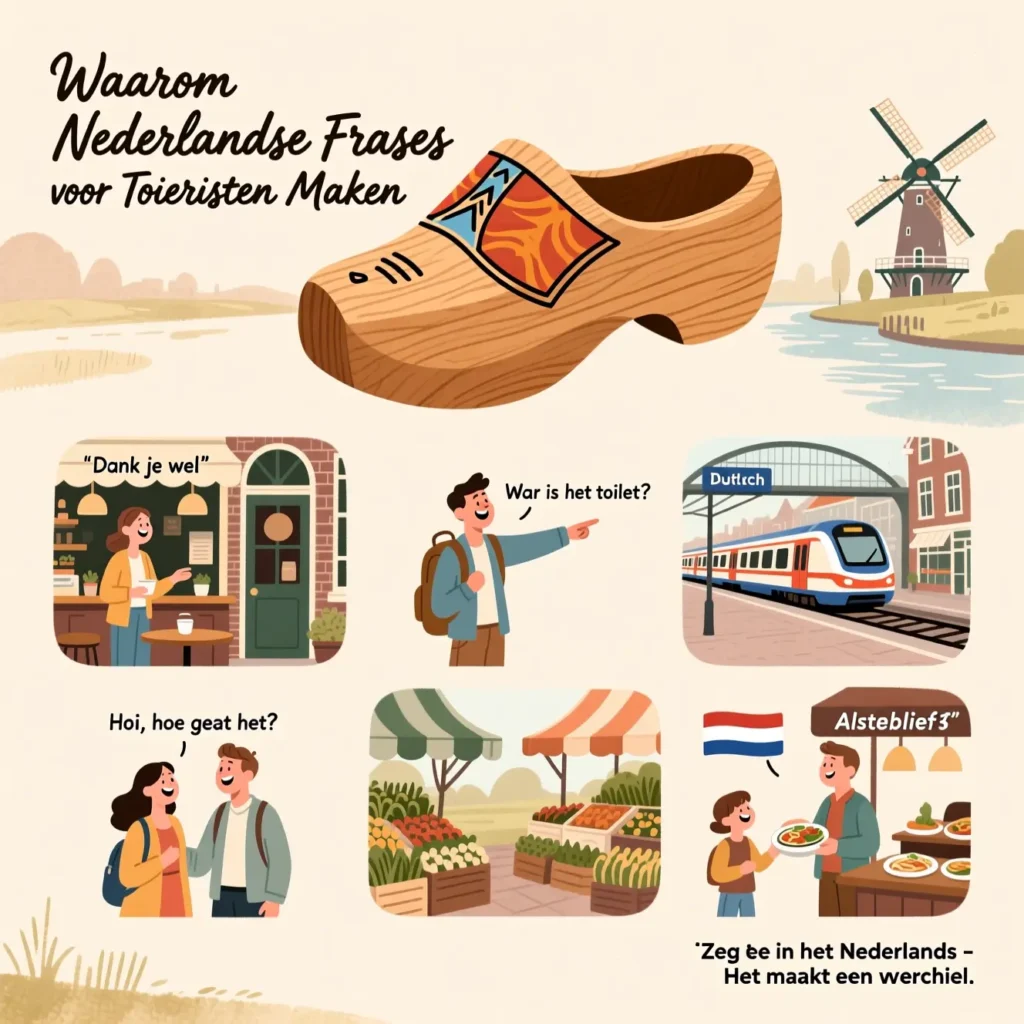
Even though many Dutch people speak English, learning Dutch phrases for tourists makes your journey smoother and more enjoyable.
A few simple words can help you order food correctly, ask for directions, understand signs, and interact politely.
It also shows respect for the local culture something Dutch people appreciate deeply.
Imagine trying to find the right train platform, paying for something in a busy shop, or asking someone for help with directions.
Using common Dutch expressions creates trust and friendliness right away. Locals may smile, respond kindly, or even offer extra help simply because you tried.
If you’re exploring museums, renting a bike, eating stroopwafels, or riding a tram through Rotterdam, these phrases will help you feel more confident and connected.
That’s why learning basic words before your trip is so important it turns every moment into a better travel experience.
Everyday Greetings and Basics 👋🇳🇱
These are the first Dutch phrases for tourists you’ll use the moment you arrive. Simple greetings help you start conversations warmly and politely.
Hallo — Hello
Explanation: A friendly and casual greeting used anytime.
Use When: Meeting someone, entering a shop, or starting any conversation.
Example: Hallo, hoe gaat het? (Hello, how are you?)
Goedemorgen — Good morning
Explanation: A polite morning greeting.
Use When: Talking to hotel staff, in cafés, or greeting people before noon.
Example: Goedemorgen! Een koffie alstublieft. (Good morning! A coffee, please.)
Goedenavond — Good evening
Explanation: Used later in the day when you want to greet politely.
Use When: Checking into a hotel at night or meeting someone after sunset.
Example: Goedenavond, is de keuken nog open? (Good evening, is the kitchen still open?)
Dank je wel — Thank you
Explanation: A warm and simple way to show gratitude.
Use When: Someone helps you, serves you, or gives information.
Example: Dank je wel voor je hulp! (Thank you for your help!)
Alsjeblieft — Please / Here you go
Explanation: Used both when making a request and when handing something to someone.
Use When: Ordering food, asking politely, or giving an item.
Example: Een water, alsjeblieft. (A water, please.)
Useful Travel and Direction Phrases 🗺️🚆
These Dutch travel phrases help you find your way around cities, trains, trams, and streets.
Waar is…? — Where is…?
Explanation: Use to ask for a location.
Use When: Searching for a station, bathroom, or famous place.
Example: Waar is het centraal station? (Where is the central station?)
Hoe kom ik naar…? — How do I get to…?
Explanation: Perfect when you need directions.
Use When: Asking locals how to reach a museum or bus stop.
Example: Hoe kom ik naar het museum? (How do I get to the museum?)
Links / Rechts — Left / Right
Explanation: Easy words to understand directions.
Use When: Following someone’s instructions.
Example: Ga links bij het stoplicht. (Go left at the stoplight.)
Ik ben verdwaald — I’m lost
Explanation: A very helpful phrase when you need assistance.
Use When: When maps aren’t helping or streets look confusing.
Example: Ik ben verdwaald, kunt u helpen? (I am lost, can you help?)
Is dit de juiste tram? — Is this the right tram?
Explanation: Especially useful in Amsterdam and Rotterdam.
Use When: Unsure if you’re boarding the correct tram.
Example: Is dit de juiste tram naar het centrum? (Is this the right tram to the city center?)
Food and Restaurant Phrases 🍽️☕
These Dutch phrases for tourists help you order confidently and enjoy Dutch food culture.
Mag ik de menukaart? — May I have the menu?
Explanation: A polite way to ask for the menu.
Use When: Sitting down at a café or restaurant.
Example: Mag ik de menukaart? (May I have the menu?)
Ik wil graag… — I would like…
Explanation: Helps you make clear and polite orders.
Use When: Ordering food or drinks.
Example: Ik wil graag een stroopwafel. (I would like a stroopwafel.)
Heeft u een vegetarische optie? — Do you have a vegetarian option?
Explanation: Great for dietary needs.
Use When: Looking for meals that suit your preferences.
Example: Heeft u een vegetarische optie? (Do you have a vegetarian option?)
De rekening, alstublieft — The bill, please
Explanation: Used when you are ready to pay.
Use When: Finishing your meal at any restaurant.
Example: De rekening, alstublieft. (The bill, please.)
Is het pittig? — Is it spicy?
Explanation: Useful if you’re sensitive to spicy food.
Use When: Checking the flavor level.
Example: Is het pittig? (Is it spicy?)
Shopping and Money Phrases 🛍️💶
Shopping in the Netherlands is fun and friendly. These phrases help you communicate clearly.
Hoeveel kost dit? — How much does this cost?
Explanation: A must-know phrase for tourists.
Use When: Asking about prices in shops or markets.
Example: Hoeveel kost dit T-shirt? (How much does this T-shirt cost?)
Kan ik pinnen? — Can I pay by card?
Explanation: “Pinnen” means to pay with a debit or credit card.
Use When: Before paying, since many places prefer card payments.
Example: Kan ik pinnen? (Can I pay by card?)
Heeft u dit in een andere maat? — Do you have this in another size?
Explanation: Useful in clothing shops.
Use When: Trying on clothes.
Example: Heeft u dit in een andere maat? (Do you have this in another size?)
Ik kijk alleen — I’m just looking
Explanation: Helps avoid pressure while shopping.
Use When: Browsing stores without wanting help.
Example: Ik kijk alleen, dank je. (I’m just looking, thank you.)
Kunt u helpen? — Can you help?
Explanation: Use when you need assistance.
Use When: Asking about products or finding something.
Example: Kunt u helpen? Ik zoek souvenirs. (Can you help? I’m looking for souvenirs.)
Emergency and help

These phrases are important for safety and emergencies.
Help! — Help!
Explanation: Simple and understood immediately.
Use When: Any urgent situation.
Example: Help! Ik heb hulp nodig! (Help! I need help!)
Bel de politie — Call the police
Explanation: For serious situations.
Use When: In case of danger or theft.
Example: Bel de politie, alsjeblieft! (Call the police, please!)
Ik heb een dokter nodig — I need a doctor
Explanation: Important for medical issues.
Use When: Feeling sick or injured.
Example: Ik heb een dokter nodig. (I need a doctor.)
Waar is het ziekenhuis? — Where is the hospital?
Explanation: Helps you locate medical services.
Use When: When someone needs urgent care.
Example: Waar is het ziekenhuis? (Where is the hospital?)
Ik spreek geen Nederlands — I don’t speak Dutch
Explanation: Useful at the start of any stressful moment.
Use When: You need someone to switch to English.
Example: Ik spreek geen Nederlands, spreekt u Engels? (I don’t speak Dutch, do you speak English?)
Polite Conversation Phrases 😊❤️
These phrases make your interactions friendlier and more respectful.
Hoe gaat het? — How are you?
Explanation: A gentle, friendly conversation starter.
Use When: Talking to locals or hosts.
Example: Hallo, hoe gaat het? (Hello, how are you?)
Geen probleem — No problem
Explanation: A casual, friendly reply.
Use When: Someone apologizes or thanks you.
Example: Geen probleem! (No problem!)
Tot ziens — See you later
Explanation: A friendly goodbye.
Use When: Leaving a shop, café, or meeting someone.
Example: Tot ziens! Fijne dag! (See you! Have a nice day!)
Fijne dag — Have a nice day
Explanation: Warm and polite phrase.
Use When: Ending any friendly conversation.
Example: Fijne dag! (Have a nice day!)
Ja / Nee — Yes / No
Explanation: Simple and essential responses.
Use When: Anywhere.
Example: Ja, dat klopt. (Yes, that’s correct.)
Bonus Recap Table (Optional) 📘
| Category | Phrase | Meaning | Example |
|---|---|---|---|
| Greetings | Hallo | Hello | Hallo, hoe gaat het? |
| Directions | Waar is…? | Where is…? | Waar is het station? |
| Food | Ik wil graag… | I would like… | Ik wil graag thee. |
| Shopping | Hoeveel kost dit? | How much is this? | Hoeveel kost dit? |
| Emergency | Ik heb een dokter nodig | I need a doctor | Ik heb een dokter nodig. |
| Politeness | Dank je wel | Thank you | Dank je wel! |
Final Thoughts
Learning Dutch phrases for tourists is a small step that makes a huge difference during your trip.
Even if you only remember a few simple words, they help you connect, communicate, and travel with confidence.
Use these phrases in restaurants, shops, trains, and everyday interactions to show respect and friendliness. The more you practice, the easier conversations become.

Leave a Reply