
Traveling to Greece feels like stepping into a world filled with warm smiles, ancient stories, sunny islands, and incredible food.
But when you can speak even a few basic Greek phrases for travel, everything becomes easier and more fun.
These simple expressions help you order meals, ask for directions, greet locals, and show respect for the culture.
You don’t need to be fluent.
You just need enough to connect and Greeks truly appreciate it when visitors try even a few words.
Why It Matters: The Power of Basic Greek Phrases for Travel
Learning basic Greek phrases for travel is more than just memorizing words. It’s about opening doors.
When you use even simple Greek greetings or polite phrases, locals often respond with kindness and sometimes even better service.
It creates connection.
Imagine:
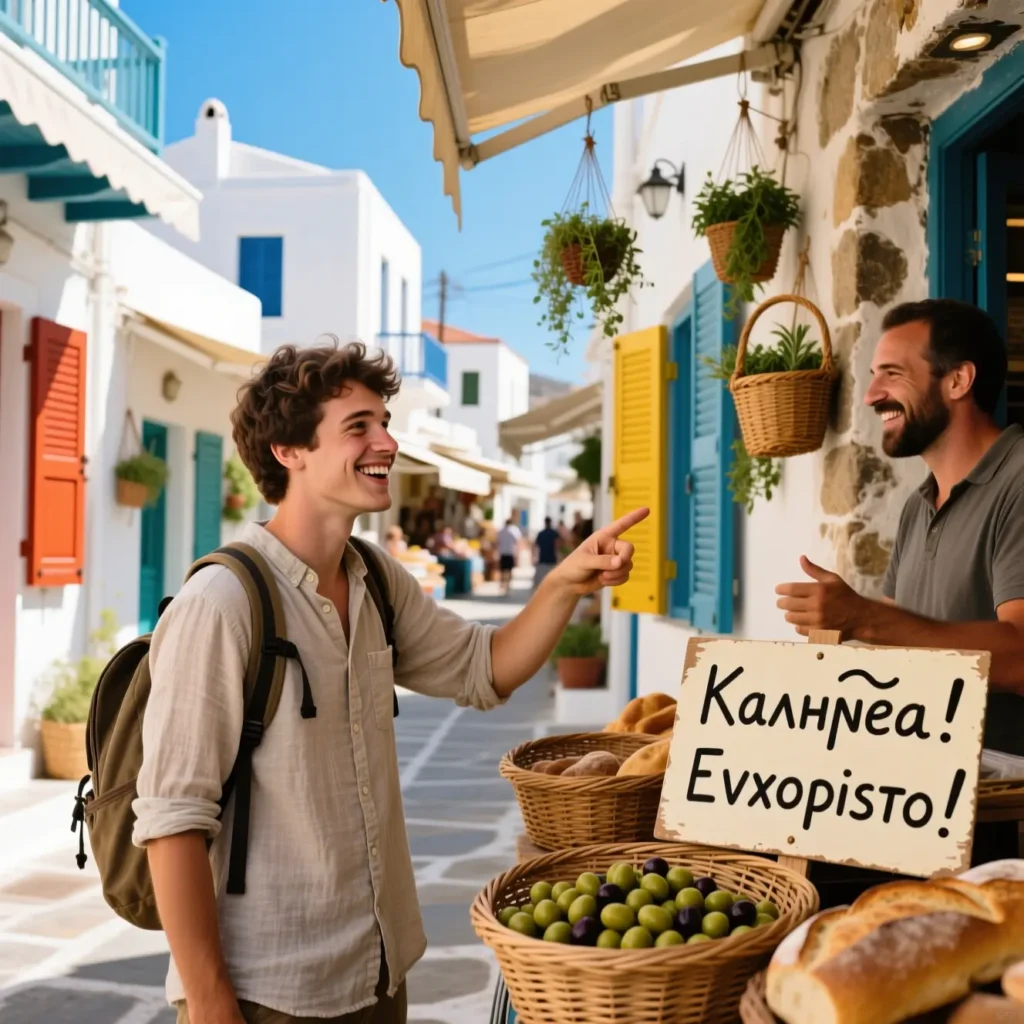
You’re in a small bakery on a quiet street. You smile and say, “Kaliméra!”. The owner’s face lights up because you used their language.
Suddenly, you’re not just a tourist. You’re a guest.
This guide helps you use Greek confidently, even if you’ve never learned another language before.
Essential Greetings and Social Phrases

Simple greetings are the heart of basic Greek phrases for travel. They help you start every interaction smoothly.
Kaliméra (Καλημέρα) — Good morning
Explanation: Used until early afternoon.
Use When: Entering a shop, greeting hotel staff, asking for help.
Example: “Kaliméra! Do you serve breakfast?”
Kalispéra (Καλησπέρα) — Good evening
Explanation: Used in late afternoon or evening.
Use When: Saying hello at restaurants or night markets.
Example: “Kalispéra! Table for two, please.”
Yássou / Yássas (Γεια σου / Γεια σας) — Hello/Hi
Explanation: Casual (yássou) vs. polite/formal (yássas).
Use When: Saying hi to locals, greeting someone new, entering shops.
Example: “Yássas! Do you have bottled water?”
Efharistó (Ευχαριστώ) — Thank you
Explanation: A polite must-know word.
Use When: After service, receiving help, buying something.
Example: “Efharistó! This looks delicious.”
Parakaló (Παρακαλώ) — Please / You’re welcome
Explanation: Works for both “please” and “you’re welcome.”
Use When: Ordering food, asking politely, responding to thanks.
Example: “One cappuccino, parakaló.”
Useful Phrases for Restaurants and Food Ordering
Food is a huge part of Greek culture, so knowing a few basic Greek phrases for travel helps you order confidently.
To menú, parakaló (Το μενού, παρακαλώ) — The menu, please
Explanation: Ask for a menu politely.
Use When: Sitting at a restaurant or café.
Example: “To menú, parakaló.”
Thélo… (Θέλω…) — I want… / I would like…
Explanation: Use before ordering.
Use When: Ordering meals, snacks, or drinks.
Example: “Thélo souvlaki, parakaló.”
Neró (Νερό) — Water
Explanation: Tap water is safe to drink in many places; bottled is common too.
Use When: Asking for water at any café or shop.
Example: “Mia fialí neró, parakaló.”
Logariasmós, parakaló The bill, please
Explanation: Ask when ready to pay.
Use When: End of your meal.
Example: “Logariasmós, parakaló.”
Eínai nóstimo! It’s delicious!
Explanation: A fun compliment Greeks love to hear.
Use When: Praising food at restaurants.
Example: “Eínai nóstimo! The best moussaka I’ve tried.”
Direction and Navigation Phrases 🗺️🚶♂️
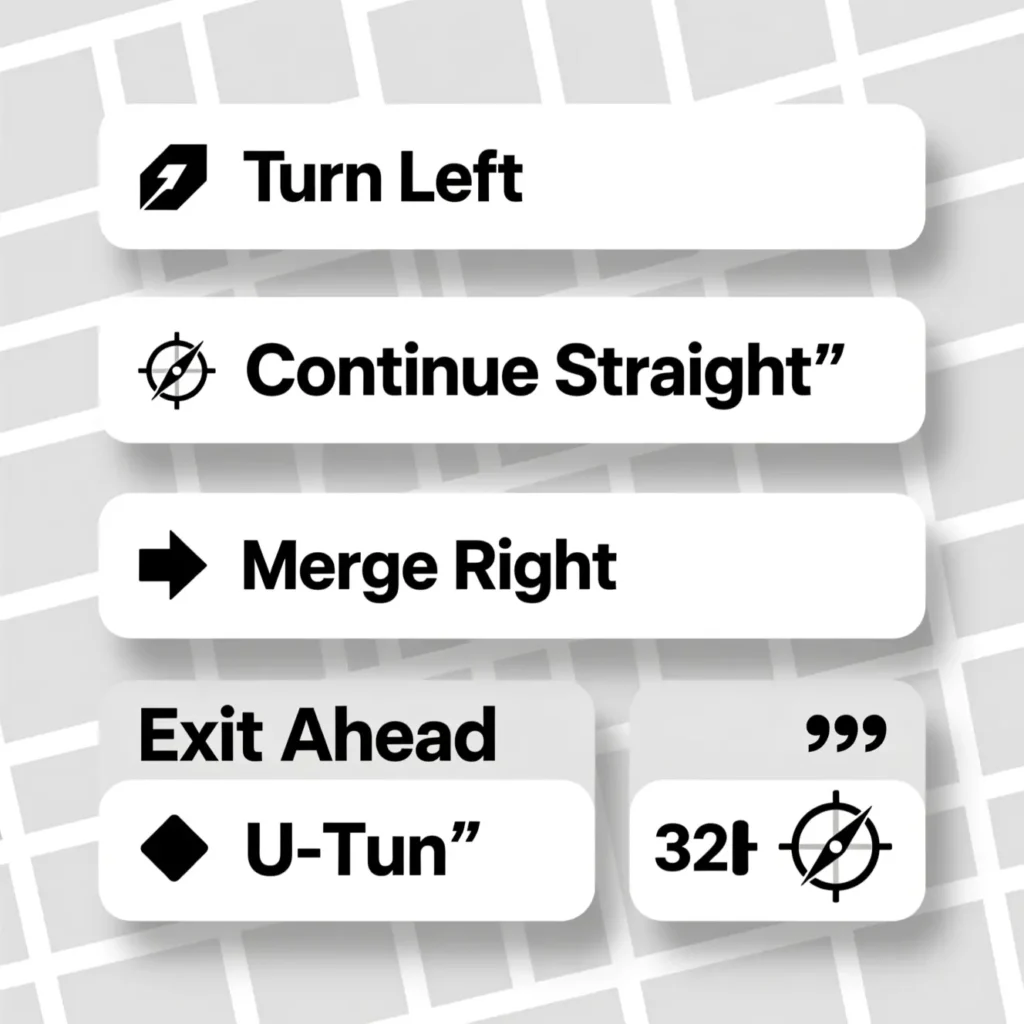
These travel phrases help you move around Greece with confidence.
Pou eínai…? — Where is…?
Explanation: A must-use question for directions.
Use When: Searching for a beach, museum, bus stop.
Example: “Pou eínai to limáni?” (Where is the port?)
Aristerá / Dexiá (Αριστερά / Δεξιά) — Left / Right
Explanation: Replies you may hear when asking directions.
Use When: Following instructions from locals.
Example: “Aristerá, metá déxia.”
Konta / Makriá (Κοντά / Μακριά) — Near / Far
Explanation: Helps you understand distance.
Use When: Asking if a place is close enough to walk.
Example: “Eínai kontá to múseio?”
Farássa / Stási (Φάρσα / Στάση) — Street / Bus stop
Explanation: Useful navigation nouns.
Use When: Asking for city locations.
Example: “Stási leoforeíou, pou eínai?”
Shopping and Buying Essentials 🛍️💶
These basic Greek phrases for travel help you shop with ease in markets and stores.
Póso káni? (Πόσο κάνει;) — How much is it?
Explanation: Main phrase for checking prices.
Use When: Buying gifts, souvenirs, food.
Example: “Póso káni aftó to magnetáki?”
Éhete…? (Έχετε…;) — Do you have…?
Explanation: Ask if a store carries something.
Use When: In supermarkets, kiosks, markets.
Example: “Éhete sunscreen?”
Thelo aftó (Θέλω αυτό) — I want this
Explanation: Useful when pointing at items.
Use When: When unsure how to name products.
Example: “Thélo aftó, parakaló.”
Boró na pliróso me káta? (Μπορώ να πληρώσω με κάρτα;) — Can I pay by card?
Explanation: Most places accept card, but not all small shops.
Use When: Before paying.
Example: “Kárta ok?”
Emergency and Safety Phrases 🚑🆘
You may never need these phrases, but they’re important.
Voítheia! (Βοήθεια!) — Help!
Explanation: Emergency call for help.
Use When: Any unsafe situation or moment of danger.
Example: “Voítheia! I need assistance!”
Hóthika (Χάθηκα) — I’m lost
Explanation: Tell someone you need help with directions.
Use When: Lost in town, on a path, or in a market.
Example: “Hóthika… pou eínai to kéntro?”
Kléthste tin astynomía (Καλέστε την αστυνομία) — Call the police
Explanation: Use in serious emergencies.
Use When: Theft, accident, urgent danger.
Example: “Parakaló, kléthste tin astynomía.”
Chriazome giatró (Χρειάζομαι γιατρό) — I need a doctor
Explanation: Useful for medical help.
Use When: Feeling sick or injured during travel.
Example: “Chriazome giatró, parakaló.”
Hotel and Transportation Phrases 🏨🚌
Great for smooth check-ins and travel.
Écho kravagéz (Έχω βαλίτσες) — I have luggage
Explanation: Common at hotel check-in or taxi stands.
Use When: Arriving at your hotel or ferry.
Example: “Écho kravagéz—can you help?”
Eínai élefteiro? (Είναι ελεύθερο;) — Is it available?
Explanation: Ask about seats, rooms, or tables.
Use When: At hotels, buses, cafes.
Example: “To trápeza eínai élefteiro?”
Ti óra fefgí? (Τι ώρα φεύγει;) — What time does it leave?
Explanation: Ask about bus, train, ferry times.
Use When: Planning transportation.
Example: “To ferri ti óra fefgí?”
Krátisi (Κράτηση) — Reservation
Explanation: A useful word for hotel or restaurant bookings.
Use When: Checking or making reservations.
Example: “Écho mia krátisi.”
Polite and Cultural Phrases for Smooth Communication 🤝🇬🇷
These show respect and friendliness.
Signómi (Συγγνώμη) — Sorry / Excuse me
Explanation: Use to get attention or apologize.
Use When: Passing someone, bumping into someone.
Example: “Signómi, can you help me?”
Miláte Angliká? (Μιλάτε Αγγλικά;) — Do you speak English?
Explanation: Most Greeks do, but this shows courtesy.
Use When: Needing detailed explanations.
Example: “Miláte Angliká?”
Chroniá pollá! (Χρόνια πολλά!) — Happy celebration / Best wishes
Explanation: Used during holidays or birthdays.
Use When: Celebrating or responding to greetings.
Example: “Chroniá pollá!” during Greek Easter.
Bonus Recap Table 📘
| Category | Phrase | Meaning | Example |
|---|---|---|---|
| Greetings | Kaliméra | Good morning | “Kaliméra! Coffee please.” |
| Food | Thélo… | I want… | “Thélo pita gyro.” |
| Directions | Pou eínai…? | Where is…? | “Pou eínai to metro?” |
| Shopping | Póso káni? | How much? | “Póso káni aftó?” |
| Emergency | Voítheia! | Help! | “Voítheia, please!” |
| Hotel/Transport | Ti óra fefgí? | What time does it leave? | “Ti óra fefgí to ferri?” |
| Politeness | Signómi | Sorry/Excuse me | “Signómi, where is the ATM?” |
Final Thoughts:
Learning basic Greek phrases for travel doesn’t have to be hard.
With just a few key words, you can connect with locals, navigate easily, and enjoy your trip more deeply.
Start with greetings, then learn restaurant and direction phrases.
Practice them every day of your trip. Don’t worry about perfect pronunciation Greeks love the effort.

Leave a Reply